
CATL’s Naxtra sodium-ion battery line entered the market with a system-level energy density of 175 Wh/kg, a figure that puts it within striking distance of entry-level lithium-iron-phosphate packs. This number is not competitive with the nickel-manganese-cobalt cells that power premium long-range electric vehicles. CATL designed this chemistry for industrial applications where space is available, weight is negotiable, and other properties dominate the purchase decision.
The Chemistry of Practical Constraints
Battery procurement in China has moved past the assumption that one cell format serves every use case. A 700-kilometre passenger sedan requires maximum energy stored in minimum volume. A grid-scale installation in Inner Mongolia, where winter temperatures drop below -20°C for weeks, requires something else entirely. Naxtra retains over 90 per cent of its discharge capacity at that temperature, outperforming lithium-iron-phosphate alternatives as the thermometer falls.
The material composition explains part of this resilience. CATL uses a Prussian white cathode paired with a hard carbon anode, a combination that eliminates lithium, cobalt, and nickel from the bill of materials. Sodium salts are abundant and geographically distributed without the concentration risks that shape lithium procurement. The resulting cost structure is most important in applications where battery packs constitute a large share of total system cost and margins are thin.
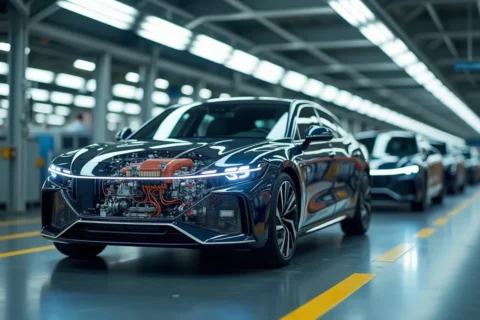
Chinese manufacturers have begun matching this chemistry to specific vehicle programmes. Chery’s QQ Ice Cream and iCAR electric models will carry Naxtra cells, targeting urban drivers whose daily distances rarely exceed 100 kilometres. Hina Battery, a competitor in the sodium-ion segment, has supplied cells for JAC Group’s Sehol E10X. These are volume vehicles for cost-sensitive buyers in cities where charging infrastructure is dense and cold-start reliability affects morning commutes. They are not halo products designed to showcase maximum range.
Trucks, Grids, and the Space Advantage
Commercial vehicle operators have different arithmetic. An urban logistics truck on a fixed depot-to-depot route does not need 600 kilometres of range. It needs predictable capital cost, operational safety, and the ability to start after an overnight freeze. Several Chinese manufacturers are piloting sodium-ion packs in light and medium-duty electric trucks for exactly this profile. The battery occupies more physical space than a lithium equivalent, but commercial chassis offer more accommodation than passenger platforms.
Stationary storage represents the most natural fit. A 1 MWh installation deployed by Hina Battery in Fuyang, Anhui province, demonstrates the logic at utility scale. Grid batteries do not move. Volume and weight constraints relax almost entirely, while cycle life, thermal stability, and material cost become decisive. Sodium-ion’s reduced thermal runaway risk simplifies fire suppression design for large installations. Its tolerance for temperature variation reduces the energy spent on climate control in outdoor enclosures.
CATL has pushed the hybrid approach further with its AB battery system, which combines sodium-ion and lithium-ion cells within a single pack. The sodium cells manage baseline power delivery and cold-weather operation. The lithium cells handle peak energy demands. This is a permanent architecture that assigns each chemistry the workload it handles best, enabled by battery management systems that can balance heterogeneous cell populations. It is not a transitional technology awaiting pure sodium maturity.
The Supply Chain as Enabler
The speed of this deployment reflects China’s integrated battery manufacturing base more than any single technical breakthrough. Vertical control from raw material processing through cell fabrication, pack assembly, and vehicle integration compresses the iteration cycle. A formulation change in the cathode material can reach vehicle testing within months rather than years because the supplier, cell maker, and OEM often operate within the same industrial region and under long-standing commercial relationships.
This proximity has allowed CATL to move Naxtra from laboratory announcement in 2021 to scheduled vehicle programmes and grid installations within roughly two years. Western battery startups with comparable chemistries typically face a fragmented supplier landscape and longer qualification timelines. The Chinese system’s density does not guarantee technical superiority in every chemistry, but it does allow faster matching of cell properties to application requirements.
The broader implication is a segmentation of the battery market by function rather than a hierarchy of better and worse technologies. Long-range passenger vehicles will continue to demand the energy density that nickel-based lithium chemistries provide. Urban EVs, commercial fleets, and grid installations will increasingly specify sodium-ion where its cost, safety, and temperature properties align with operational reality. CATL’s 175 Wh/kg figure is a precise calibration of where sodium becomes the rational choice, not a step toward replacing lithium.