
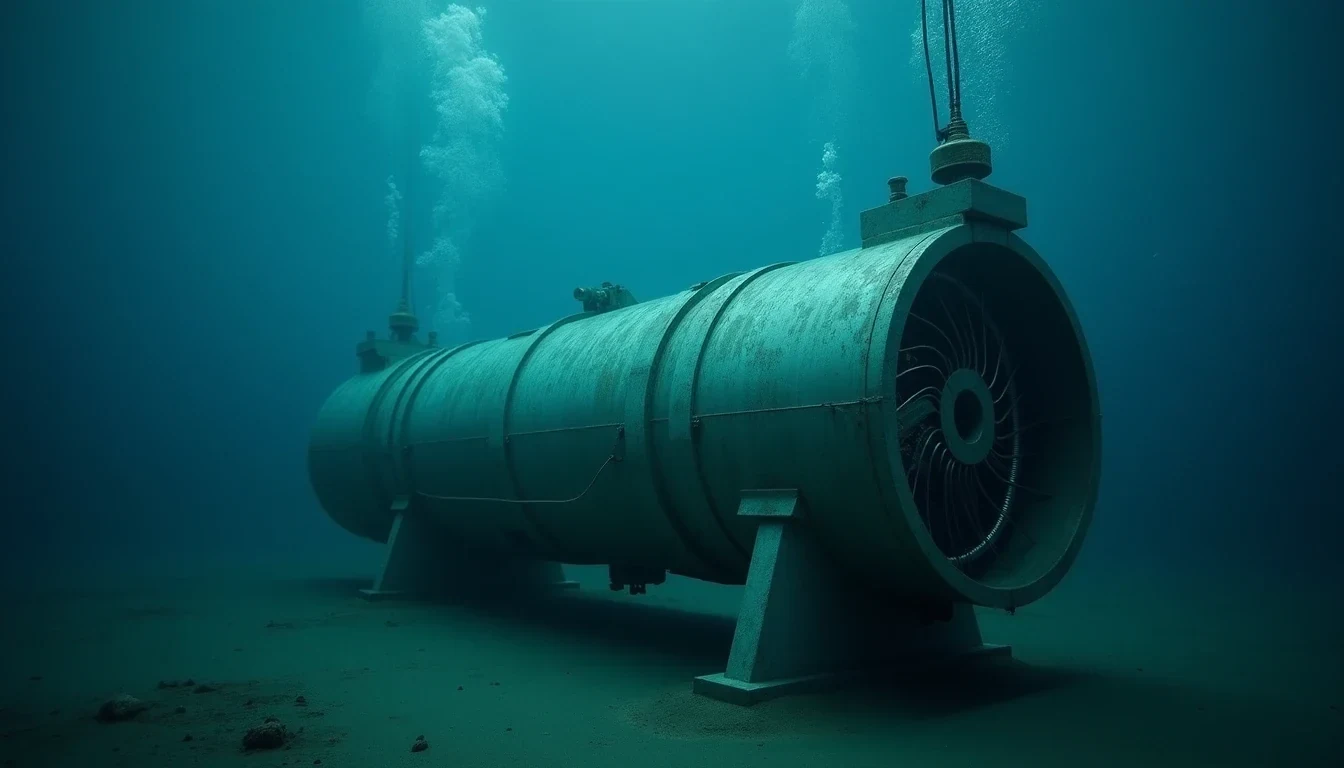
A sealed cylinder of servers now sits on the seabed off Shanghai Lingang, drawing electricity from turbines spinning above the surface and dumping its waste heat into the East China Sea. The facility entered commercial operation this year with a 2.3 megawatt first phase, a designed power-usage effectiveness of roughly 1.15, and a planned expansion to 24 megawatts. Those numbers place it among the most efficient operational data centers anywhere because it treats the ocean as infrastructure, not an obstacle.
The project follows three years of continuous operation at a smaller commercial facility near Hainan. Engineers have kept submerged computing modules online there since 2023 and later added hundreds of high-performance servers to the underwater array. Hainan provided the running proof that sealed modules could survive pressure, salinity, and biological fouling long enough to justify larger capital commitments. Shanghai Lingang is the scaled response, not the experiment.
How the System Works
The physical design is straightforward in concept and demanding in execution. Computing hardware resides in pressure-resistant, watertight modules anchored to the seabed. Cold seawater surrounds the enclosures, absorbing heat through the module walls without pumps, chillers, or evaporative cooling towers. Nearby offshore wind turbines deliver electricity through submarine cables, co-locating generation and consumption tightly enough to limit transmission losses.
This arrangement eliminates three persistent drains on conventional facilities. The Shanghai Lingang project reports a 22.8% reduction in electricity consumption against land-based equivalents, zero freshwater withdrawal for cooling, and a land footprint reduced by more than 90%. For a country where coastal industrial land carries premium pricing and northern provinces face chronic water stress, these are not marginal gains. They reshape where and how compute infrastructure can be deployed.
From Hainan’s Testbed to Shanghai’s Scale
The Hainan facility’s operational record since 2023 supplied the empirical foundation for Lingang’s larger bet. Engineers there validated corrosion protection protocols, monitored seal degradation under sustained hydrostatic pressure, and refined techniques for remote diagnostics with minimal human intervention. The later addition of high-performance server modules confirmed that the cooling capacity could meet densities required for AI training workloads, not just storage or light computation.
Shanghai Lingang applies those lessons directly. Its modular architecture allows phased expansion: the current 2.3 MW operating phase can grow toward the 24 MW ceiling as demand and financing permit. This incremental approach reduces the capital risk of a novel build, matching deployment to actual uptake rather than speculative overbuild.
The Engineering Still Unfinished
Submerged operation introduces failure modes that land-based engineers rarely confront. Saltwater corrosion acts continuously on every external surface, demanding material selections and protective coatings validated for multi-year exposure without maintenance access. Hydrostatic pressure at operational depth loads seals and hull structures cyclically as tides shift and weather systems pass. Biofouling, the gradual accumulation of marine organisms on external surfaces, can insulate heat exchangers and degrade cooling performance if not anticipated in the thermal design.
Long-term maintenance remains the most stubborn constraint. Retrieving a module for component replacement costs substantially more than walking a server room aisle. The economic case for underwater deployment depends on driving failure rates low enough that remote monitoring and predictive replacement dominate over physical intervention. That reliability target is achievable, but it requires manufacturing precision and quality control at levels that raise unit costs before volume production can amortize them.
Scaling the manufacturing and deployment pipeline presents a parallel challenge. Each module must be fabricated, pressure-tested, transported, and installed with procedures closer to subsea oilfield equipment than to standard data center construction. The Hainan-to-Lingang progression demonstrates that these steps are executable. Whether they can be compressed in cost and timeline for widespread replication remains the open question.
Why This Fits China’s Industrial Trajectory
The underwater data center program aligns with several concurrent priorities in Chinese industrial policy. The country has invested heavily in offshore wind capacity along its southeastern coast. Direct consumption by submerged compute facilities improves utilization of that generation and reduces curtailment when grid absorption lags. AI and high-performance computing demand is growing faster than land-based power and cooling infrastructure can accommodate in dense coastal zones where talent and connectivity cluster. Subsea deployment offers a spatial workaround.
More specifically, the initiative leverages existing Chinese strengths in marine engineering, modular construction, and renewable integration rather than requiring breakthroughs in unfamiliar domains. The sealed computing modules draw on shipbuilding and offshore platform expertise. The wind-to-wire integration applies lessons from a decade of coastal wind farm development. The result is a system that looks radical in concept but incremental in its component technologies. This pattern tends to travel faster from demonstration to deployment in Chinese industrial planning than in markets where novel projects must assemble private capital piecemeal.
What Comes Next
The 24 MW planned capacity at Shanghai Lingang, if fully realized, would represent a meaningful commercial scale rather than a pilot curiosity. For context, a single large AI training cluster can demand tens of megawatts continuously. Lingang’s eventual output could support substantial model training or inference loads without adding to land or freshwater constraints.
Whether the model exports globally depends on how aggressively engineering teams can drive down the cost curve for module fabrication and seabed installation. Coastal markets with land scarcity, water limitations, or strong renewable offshore wind resources (Japan, South Korea, parts of Northern Europe, the US Atlantic coast) present obvious analogies to the Chinese conditions that motivated the initial investment. None yet have operational equivalents. The window for first-mover advantage in establishing technical standards and supplier relationships for subsea compute infrastructure is open, and Chinese entities are currently the only ones walking through it.
The Hainan facility proved the concept could survive. Shanghai Lingang is testing whether it can compete. The next facilities, wherever they deploy, will determine whether underwater data centers become a permanent category of global infrastructure or remain a regional specialization for a specific coastline’s constraints.