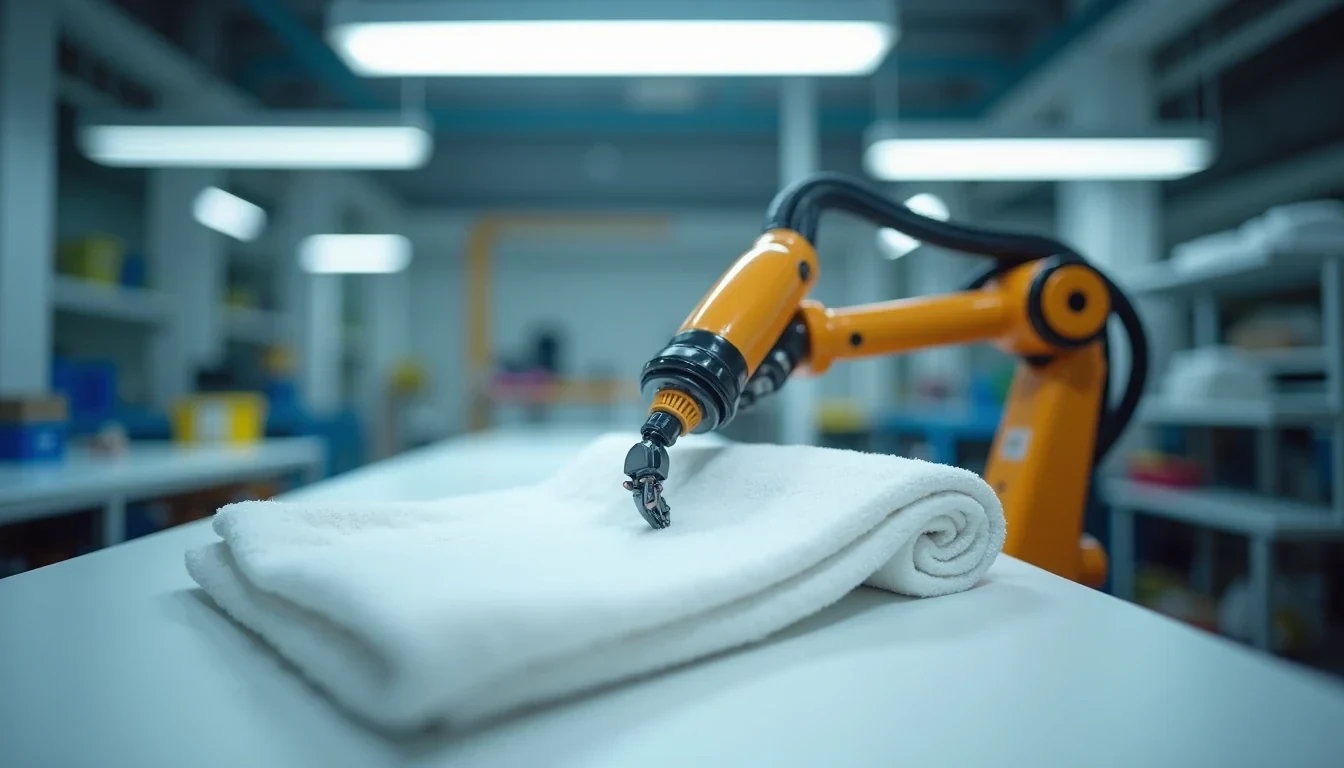
A robot in Shanghai has spent the last three hours trying to fold a towel. It has failed at least forty times. Each failed grasp, dropped corner, and misaligned fold has been logged, labeled, and fed into a training pipeline. This pipeline will shape how the next generation of machines handles fabric, components, and unfamiliar objects across Chinese factories. This is not a malfunction; it is the product.
AgiBot’s Shanghai facility deliberately inverts how artificial intelligence typically learns. Large language models train on text scraped from the internet, images pulled from photo libraries, and code copied from repositories. Embodied intelligence cannot learn this way. No archive exists of how much force a gripper must apply before silk slips, or how a door handle resists when its latch mechanism is worn. These machines must generate their own curriculum through repeated physical encounter. China has begun building the industrial infrastructure to manufacture that curriculum at scale.
The Data Problem Physical AI Cannot Avoid
Traditional AI systems learn from representation. A multimodal model processes millions of photographs of cups and develops statistical associations between visual patterns and the word “cup.” An embodied robot must learn what a cup actually is: its weight distribution when full versus empty, the thermal conductivity of ceramic versus metal, and the precise coefficient of friction between glaze and silicone gripper pad. These properties resist digitization; they must be encountered.
This creates a data bottleneck that has constrained robotics for decades. Simulation can approximate physics, but real materials deform in ways that break simplified models. A simulated cloth folds cleanly along predicted creases; real cotton bunches, static-clings, and reveals weave irregularities that defeat the model. The gap between simulation and reality, known as the “reality gap,” means that skills learned in virtual environments often fail when transferred to physical hardware.
China’s response treats this gap not as a research problem to be solved algorithmically, but as a manufacturing problem to be solved industrially. If the data does not exist, China builds factories to produce it.
How Robot Data Factories Operate
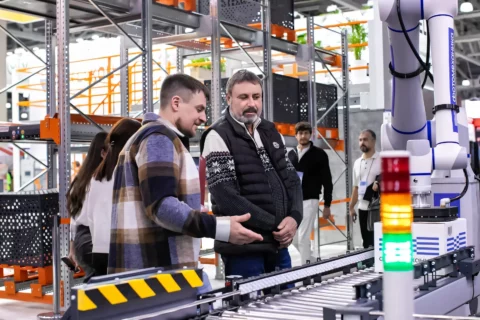
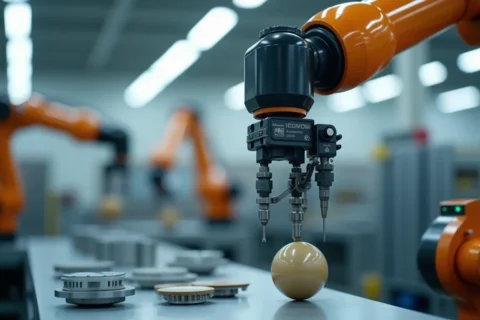
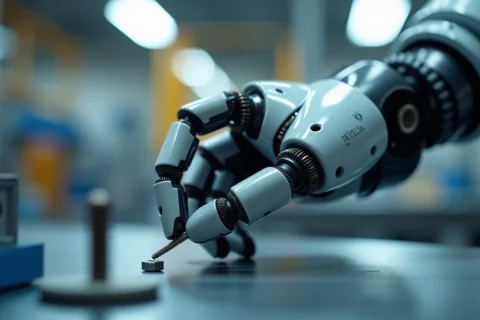
AgiBot’s Shanghai center runs a continuous cycle of attempted tasks. Robots equipped with RGB cameras, depth sensors, force-torque transducers at the wrist and gripper, and tactile arrays on contact surfaces repeat motions under varying conditions. The same component insertion might be attempted with the piece rotated fifteen degrees, under warmer ambient temperature, or against a slightly worn fixture. Each variation generates a distinct data point.
Human operators structure this process. They define task parameters, arrange physical environments, and provide initial demonstrations through teleoperation when a skill has no existing training foundation. When a robot fails, operators classify the failure mode: slipped grasp, collision with unexpected obstacle, force threshold exceeded, or visual misidentification. This labeling converts raw sensor streams into supervised learning material.
The critical output is negative examples. A language model trains predominantly on coherent text; incoherent text is discarded. Embodied AI requires failure states. A dataset of ten thousand successful grasps teaches less than a dataset of eight thousand successes plus two thousand failures, each tagged with the specific physics that produced it. The Shanghai facility systematically generates these failures.
Comparable operations in Beijing and Shenzhen apply the same methodology to different task domains. Beijing centers reportedly emphasize industrial assembly operations, component handling, and precision insertion tasks relevant to electronics manufacturing. Shenzhen facilities focus on logistics, packaging, and the manipulation of consumer goods with highly variable geometries. The geographic distribution aligns with existing manufacturing specializations, allowing data collection to map directly onto anticipated deployment environments.
The Infrastructure Logic
China’s approach treats physical training data as a strategic resource comparable to energy generation or semiconductor fabrication capacity. Whoever operates the most robots, generating the most diverse failure and success examples, will train the most capable embodied models. Volume becomes quality through statistical coverage.
This logic draws on existing industrial scale. Chinese factories already operate thousands of robotic arms in automotive welding, electronics assembly, and logistics sorting. Retrofitting these installations with comprehensive sensor suites and data logging infrastructure converts production equipment into training equipment. A welding robot that has performed millions of joints possesses latent data that, if properly captured and labeled, describes how metal behaves under controlled thermal and mechanical stress.
The dedicated training facilities extend this principle. Factory robots optimize for throughput, while training robots optimize for variability. They perform tasks slowly, under modified conditions, with explicit permission to fail. The Shanghai facility’s towel-folding robot is not producing linens for sale. It is producing the data that will allow future robots to handle fabrics, flexible materials, and deformable objects across textile, medical, and domestic applications.
Implications for Competitive Positioning
The systematic collection of physical interaction data creates defensive advantages that resist rapid replication. A competitor can purchase equivalent hardware, hire comparable engineering talent, and access published research. They cannot quickly generate equivalent training datasets, because data accumulation is inherently time-bound and path-dependent. The specific sequence of failures encountered, the particular environmental variations tested, and the accumulated operator annotations constitute institutional knowledge embedded in data archives.
China’s manufacturing density amplifies this effect. The concentration of electronics assembly, battery production, automotive manufacturing, and consumer goods packaging within domestic supply chains means that training data can be collected against the actual objects, components, and materials that robots will later manipulate in production. A training center in Shenzhen can source the precise packaging film, the exact connector geometry, and the specific surface finish that appears in neighboring factories.
Western robotics development has historically prioritized simulation, algorithmic efficiency, and hardware sophistication. The Chinese approach sacrifices some algorithmic elegance for data volume, betting that empirical coverage of physical phenomena will produce more robust real-world performance. The outcome will depend on whether the reality gap narrows faster through better simulation or through industrial-scale data collection.
The towel-folding robot in Shanghai will eventually succeed consistently. When it does, the dataset of its failures will prove more valuable than the working skill itself.