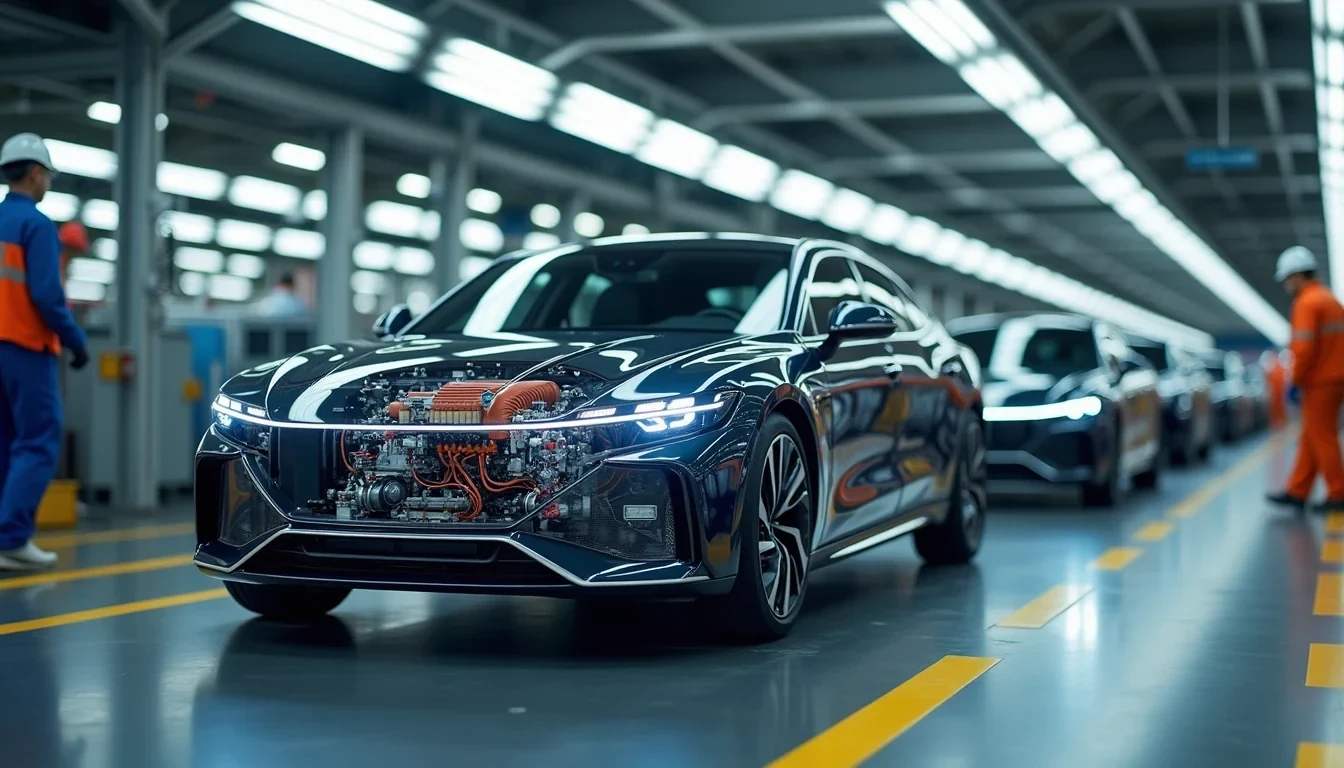
A Xpeng P7i rolling off the line in Guangzhou carries more raw compute than most data centers had a decade ago. Two Orin chips, eleven cameras, two lidar units, and a battery pack thermally managed to keep those processors fed under full load. The vehicle is no longer a chassis with an engine bay waiting for electronics to be grafted on. It is a single hardware stack where the battery, the central computer, the sensor array, the operating system, and the trained neural networks are designed as one coordinated system. The companies building them are moving faster than any traditional automotive development cycle allows.
This is the practical result of China’s push to make intelligent connected vehicles a pillar of industrial policy through 2026. The New Energy Vehicle Industry Development Plan and parallel guidance from ministries including MIIT and NDRC have created a framework where automakers must embed AI from the architecture up, not bolt it on after the body panels are stamped. Funding flows to domestic chip design, C-V2X infrastructure rolls out across the Yangtze River Delta and Beijing-Tianjin-Hebei corridors, and national standards for data security and over-the-air updates give manufacturers a clear path to deploy. The policy removes the option of treating electrification as the endpoint.
The Stack as Product
The physical manifestation of this strategy is a domain-centralized computing architecture that replaces the scattered electronic control units of past vehicles with powerful central nodes. Qualcomm’s Snapdragon 8295 handles cockpit duties in multiple brands. NVIDIA’s Orin drives perception and planning for advanced driver assistance. Huawei’s Ascend chips, delivered through its MDC 610 and MDC 810 platforms, power intelligent driving for partners including Changan, BAIC, and GAC. Horizon Robotics supplies its Journey 5 processors to Li Auto, BYD, Nio, Great Wall, SAIC, and others, taking an open-platform approach that lets automakers build differentiation on shared silicon.
Sensors feed these processors in redundant layers. Eight-megapixel cameras capture visual detail at distance. Lidar units from Hesai and RoboSense provide precise depth mapping. Millimeter-wave radar fills gaps in weather, and ultrasonic sensors handle close maneuvering. The data flows across automotive Ethernet backbones fast enough to fuse these streams in real time. The battery system is engineered to deliver stable, high-current power to the compute platform without sacrificing range or thermal stability.
The operating systems binding this hardware are proprietary. Xpeng runs XOS. Nio deploys Banyan. Xiaomi has built HyperOS for automotive. Huawei offers HarmonyOS. Each manages both cockpit interaction and driving functions through unified software layers, and each receives updates that can alter vehicle behavior months or years after the initial sale.
What the Software Actually Does
The capabilities reaching ordinary buyers are moving past assisted highway cruising into genuinely complex environments. Xpeng’s Navigation Guided Pilot operates across expanding urban road networks, handling traffic lights, unprotected left turns, and dense lane changes through over-the-air expansion. Nio’s NOMI voice assistant processes multi-zone natural language requests with contextual memory, controlling climate, navigation, and vehicle settings without rigid command structures. Memory parking learns frequently used spaces and reproduces the maneuver autonomously. Valet parking allows remote summoning in supported structures.
Driver monitoring systems track attention and fatigue through cabin-facing cameras, intervening with alerts or direct braking when distraction crosses thresholds. Biometric recognition personalizes settings, authorizes payments, and secures vehicle access. City Navigation Pilot features from Huawei’s ADS, deployed in AITO vehicles, demonstrate what full-stack vertical integration from chip to cloud can deliver in live traffic.
The critical difference is pace. Xpeng, Nio, and Li Auto push substantial feature updates every one to three months. Beta deployments to early adopters generate real-world data that feeds rapid iteration. Traditional automakers locked into three-to-five-year platform cycles, dependent on Tier 1 suppliers for major subsystems, cannot match this rhythm. A capability demonstrated in software at a Chinese tech conference often reaches production vehicles before a comparable feature completes validation at a legacy OEM.
The Supplier Layer Behind the Brands
Huawei and Horizon Robotics have become infrastructure for the entire sector rather than captive arms of single manufacturers. Huawei’s Intelligent Automotive Solution unit offers everything from bare chips to complete autonomous driving stacks, deployed either as supplier contracts or through joint ventures like AITO. Horizon Robotics provides the Journey series chips with software development kits that let each automaker customize perception, prediction, and planning models while sharing the underlying silicon investment.
This dual approach solves a scaling problem. Individual Chinese EV brands, even large ones, lack the capital to design bespoke chips at competitive performance levels. By sourcing from domestic suppliers with government-backed R&D support, they gain access to hardware that matches or exceeds global alternatives while maintaining software independence. BYD, Nio, Xpeng, Xiaomi, and state-owned manufacturers can all claim differentiated AI experiences built on partially shared foundations.
Market Consequences
Domestically, these capabilities have become primary purchase drivers in a crowded field. Tech-savvy buyers in Shanghai, Shenzhen, and Chengdu evaluate vehicles on voice responsiveness, ADAS coverage maps, and update cadence as heavily as range or charging speed. The vehicle that improves itself quarterly retains perceived value longer than one locked to its factory software.
For exports, the AI-first positioning reframes Chinese EVs from budget alternatives to technology leaders. European and Southeast Asian buyers encountering BYD’s intelligent cockpit or Xpeng’s urban navigation features are experiencing capabilities often reserved for premium segments or still in pilot programs at Western brands. The technological gap becomes a pricing lever, allowing penetration above commodity levels and opening subscription revenue for advanced functions.
The 2026 strategy deadline is approaching. What exists now in pilot zones and flagship models is being compressed toward mass-market ubiquity. The stack is already defined. The remaining question is which manufacturers can integrate it fastest, and whether any traditional automotive power can restructure quickly enough to compete with the timeline Chinese policy has set.