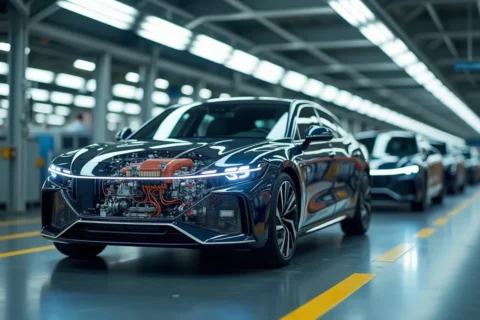

Nio’s 5nm Yang Jian processor, taped out last year for its Aquila computing platform, carries a pointed message: China’s largest EV builders are ending the era of buying off-the-shelf intelligence. The chip replaces Nvidia’s Orin in future vehicle generations, signaling that Chinese automakers now treat semiconductor architecture as a core competency, not a procurement decision.
This reorientation is accelerating across the sector. Leapmotor’s Lingxin 01, developed with Dahua Technology, has been in production since 2021 with 8.4 TOPS of AI compute. Geely’s ECARX subsidiary produces both Antelope cockpit processors and the Shenjing 7nm ADAS chip. BYD, through BYD Semiconductor, manufactures its own IGBTs for motor control and MCUs for battery management at volumes that make it one of the largest domestic producers of automotive power electronics. Even SAIC, traditionally more conservative in vertical integration, has established Z-ONE Software Company to build central computing units that will likely feed into custom silicon strategies.
The pattern is unmistakable. Companies that once differentiated through battery range or interior screens are now competing on who controls the compute substrate beneath the software.
Why Hardware Control Became Strategic
Geopolitical risk is the immediate catalyst. US export controls on advanced AI accelerators, including restrictions on Nvidia’s A100 and H100 equivalents reaching Chinese entities, have turned foreign chip dependency from a cost issue into an operational vulnerability. The push predates these specific measures. The COVID-era semiconductor shortage exposed how a single constrained component could idle entire vehicle assembly lines, and Chinese manufacturers absorbed that lesson with characteristic intensity.
This wave of internalization is technically ambitious. These are not commodity replacements. Nio’s Yang Jian is fabricated at 5nm, placing it among the most advanced automotive processors globally. The design targets are specifically demanding: real-time sensor fusion for autonomous driving, neural network inference for driver assistance, and the concurrent processing loads of digital cockpits running multiple displays and passenger entertainment systems.
Custom silicon delivers advantages that purchasing standard parts cannot replicate. Hardware-software co-design allows algorithms to be optimized against known circuit characteristics rather than adapted to generic architectures. Latency drops, power efficiency improves, and features that would strain off-the-shelf solutions become feasible. The resulting systems are harder to reverse-engineer. A competitor can buy the same Nvidia Orin board; it cannot easily duplicate the tight coupling between Nio’s proprietary perception stack and the Yang Jian’s specific compute allocation.
The Speed Argument
Development velocity separates this strategy from mere nationalism. Tesla’s FSD chip demonstrated the template: by designing its own silicon, Tesla integrated Autopilot iterations faster than rivals dependent on external roadmaps. Chinese manufacturers have studied this precedent closely.
Concurrent engineering is the operational mechanism. When Nio’s chip architects and its ADAS software engineers share specifications in development rather than at integration, optimization loops compress dramatically. Software teams can begin targeting future architectures before silicon returns from the foundry. Verification happens against actual use cases rather than vendor reference designs. The traditional sequence of chip availability, software porting, and system debugging collapses into parallel tracks.
In the Chinese EV market, the competitive cycle has compressed to roughly 12-18 months for meaningful feature updates. A supplier like Nvidia operates on its own timeline, prioritizing across automotive, data center, and robotics customers. An automaker controlling its own silicon sets its own release cadence.
The Talent and Capital Burden
The obstacles to executing this strategy are substantial and frequently underestimated. Automotive-grade chip design requires expertise that remains scarce even in China’s deep engineering pool. Verification engineers familiar with ISO 26262 functional safety standards, architects who can balance thermal constraints against compute density, and physical designers capable of 5nm implementation command compensation packages that rival senior vehicle platform executives.
The financial requirements scale quickly. A modern automotive SoC demands hundreds of millions of dollars before first silicon, encompassing ARM core licenses, GPU IP, EDA tool subscriptions, and mask costs at advanced nodes. The development cycle stretches 3-5 years from architecture to mass production, longer than typical vehicle platform timelines and requiring accurate prediction of future software requirements.
Manufacturing access adds further complexity. Leading-edge production remains concentrated at TSMC, where Chinese automotive customers compete for allocation against smartphone and AI accelerator demand. Domestic foundry SMIC offers alternative capacity at less advanced nodes, but the performance tradeoffs for autonomous driving compute are significant. Geopolitical restrictions on technology transfer continue to tighten, potentially affecting future node access.
The Foreign Supplier Recalculation
For Nvidia, Qualcomm, and other established automotive semiconductor suppliers, this trend demands strategic adjustment. The Chinese market represented one of the fastest-growing revenue segments for their automotive divisions. Nio’s Yang Jian directly displaces Orin volumes. ECARX’s Antelope series competes with Qualcomm’s Snapdragon cockpit platforms. The replacement is not total; these companies retain positions in brands that have not pursued vertical integration, but the growth trajectory has clearly shifted.
The more sophisticated response from foreign suppliers involves emphasizing software ecosystems and development tools that remain sticky even when hardware is displaced. Nvidia’s DRIVE platform, with its simulation and training infrastructure, offers value beyond the silicon itself. Qualcomm’s cellular and Wi-Fi connectivity solutions are harder for automakers to replicate. The core processing layer, the highest-margin segment of automotive semiconductor supply, is increasingly contested.
What emerges is a bifurcated market. Premium Chinese EV builders with sufficient scale—Nio, BYD, Geely, Xpeng—are internalizing the most differentiation-critical processors while maintaining supplier relationships for commodity components. Second-tier manufacturers lacking the capital or volume to justify custom silicon remain dependent on foreign suppliers, accepting the standardization that comes with off-the-shelf solutions.
The competitive implication is stark. The gap in software-defined capabilities between silicon owners and silicon buyers is likely to widen, not narrow, as autonomous driving and cockpit intelligence become the primary purchase differentiators. Chinese automakers have placed their bets accordingly.