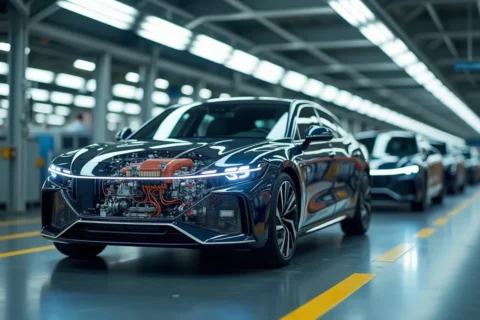

A single BYD Han L pulling up to a megawatt charger adds roughly 400 kilometres of range in five minutes. That figure has circulated widely since the Super e-Platform announcement. The number that actually matters sits behind the charging screen: one megawatt sustained, repeated, and multiplied across ten stalls without melting cables or browning out the local grid. The charger itself is almost the least interesting part of what BYD and its partners are building.
The Plug Is a Small Piece of a Large Power System
The hardware that meets the driver is a liquid-cooled cable and connector rated for extreme current. Everything else at the site resembles a small industrial substation more than a petrol pump. Medium-voltage grid connections at 10kV or 35kV bypass ordinary commercial feeds entirely. Dedicated transformers, reinforced switchgear, and heavy-gauge underground cabling form the backbone. Inside the station, busbar systems distribute power across charging modules that generate enough waste heat to require closed-loop liquid cooling with pumps, heat exchangers, and radiators borrowed from data centre thermal designs.
The real complexity emerges when multiple vehicles charge simultaneously. Ten stalls each drawing near a megawatt create a 10 MW aggregate load, equivalent to a small factory or several thousand homes hitting peak demand at once. Without intervention, that spike would trigger exorbitant demand charges and voltage sags that destabilise surrounding distribution networks. A Battery Energy Storage System, typically 1–5 MWh, solves this problem. It trickle-charges from the grid overnight and discharges rapidly during peak events. An advanced Power Management System orchestrates the flow between grid, storage, and vehicles in real time, load-balancing across stalls and prioritising based on state of charge.
Each station transforms into a microgrid hub with its own protection systems, harmonic filters, and cybersecurity architecture. The charging site is no longer a retail amenity; it is a piece of energy infrastructure that happens to have customer-facing terminals.
Why China Can Coordinate What Fragmented Markets Cannot
The vertical integration that defines China’s EV sector turns this complexity from a deployment barrier into a scheduling problem. BYD manufactures the vehicle, the Blade Battery, the power electronics, and increasingly the semiconductors that control them. CATL supplies cells optimised for high-rate charging to multiple OEMs while collaborating on pack designs. State Grid Corporation of China, the world’s largest utility, upgrades distribution networks according to national plans that already specify charging network capacity needs and locations.
This is not theoretical coordination. The ChaoJi charging standard, developed with government standards bodies and now pushing toward 900 kW and beyond, ensures that every component in the chain speaks the same protocol. There is no equivalent of the CCS-versus-NACS fragmentation that has slowed US infrastructure, or the aftermarket adapter market that adds cost and failure points elsewhere. When BYD designs a thermal management system for its Blade Battery, it knows exactly what the charging module’s cooling loop can handle because both came from the same engineering organisation.
State-owned enterprises and major private operators like TELD and Star Charge have already deployed 600 kW+ stations nationwide. These serve as the foundation for megawatt upgrades: the grid connections, storage enclosures, and power management software are designed for expansion rather than replacement. The “chicken-and-egg” problem of waiting for vehicles before building infrastructure, or building infrastructure before vehicles can use it, largely dissolves when national Five-Year Plans set targets for both simultaneously and when the same industrial ecosystem supplies both sides.
The Scale of What Repeated Megawatt Delivery Requires
The thermal arithmetic alone explains why this remains infrastructure rather than consumer electronics. A megawatt transfer generates resistive heat throughout the chain: transformers warming, power electronics demanding active cooling, and cables requiring liquid circulation to remain touchable. Multiple simultaneous transfers multiply the heat load without multiplying the physical space proportionally. Redundant cooling loops become essential. Component failure at these power densities carries consequences beyond a single stalled charging session.
Grid stability compounds the challenge. Fluctuating multi-megawatt loads introduce harmonic distortion that degrades power quality for other users. Active filters and reactive power compensation add cost and complexity that no single charger manufacturer controls. Voltage regulation must happen in coordination with the local utility. In China’s case, this means coordination with an entity that operates under the same national planning framework that mandated the charging network in the first place.
Cybersecurity, often treated as an afterthought in consumer-facing installations, becomes critical infrastructure protection when stations represent grid-edge control points with two-way communication to distribution management systems.
What Western Markets Would Have to Replicate
The integrated rollout that BYD and its domestic competitors are executing depends on capabilities that do not travel easily. Vertically integrated manufacturing from cell to vehicle to power semiconductor is rare outside China. Utility-scale grid upgrades coordinated with private charging deployment require regulatory frameworks that most markets lack. Standard-setting bodies with enforcement power, rather than industry consortia with recommendations, are similarly scarce.
The technical components—liquid cooling, battery storage, power management software—are individually available globally. What is not readily exportable is the systemic coordination that deploys them as a functioning network rather than a collection of pilot projects. A single megawatt charger can be purchased. A hundred of them operating reliably across a metropolitan grid, with vehicles that can accept the power, batteries that can survive the cycle rate, and utilities that planned for the load years in advance, is a different category of achievement.
BYD’s five-minute charging claim is a product specification. The infrastructure required to make that specification routinely achievable is an industrial system, and China has spent two decades assembling that system.