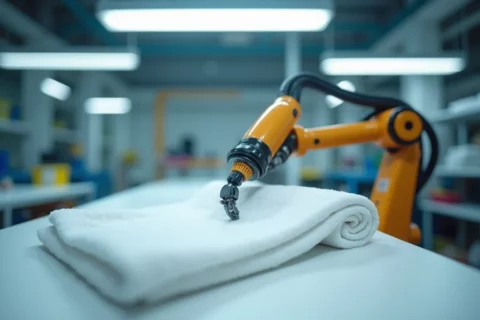
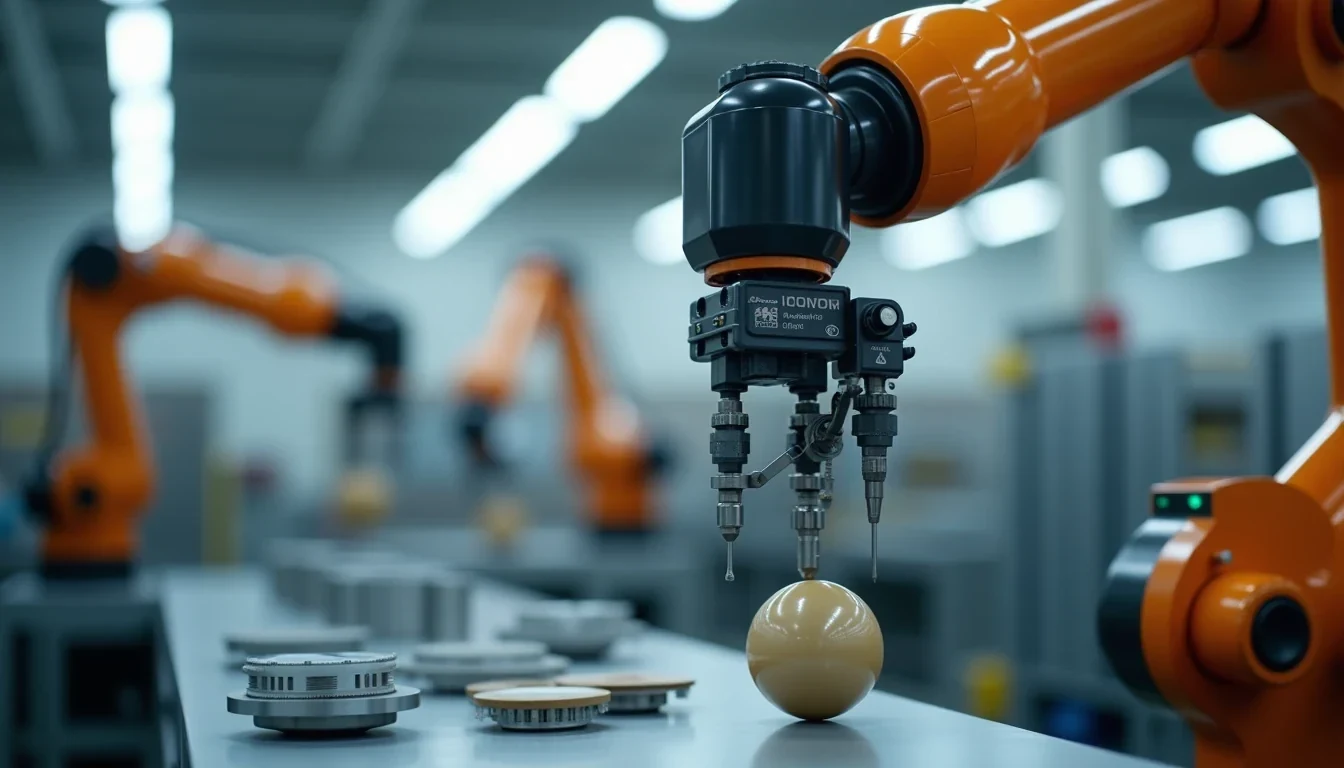
A factory manager in Dongguan weighing automation options faces a straightforward calculation. A six-axis collaborative robot arm from JAKA Robotics or Estun runs between 180,000 and 700,000 yuan installed. It welds, picks, or assembles indefinitely at a fixed station without breaks, compensation disputes, or dormitory costs. A bipedal humanoid capable of the same task costs an order of magnitude more, drains its battery within two to four hours, and must devote continuous computational resources simply to remain upright. This is a procurement decision, and China’s industrial buyers are voting with purchase orders for arms, grippers, and mobile bases while full humanoids remain laboratory curiosities.
The Form That Follows the Invoice
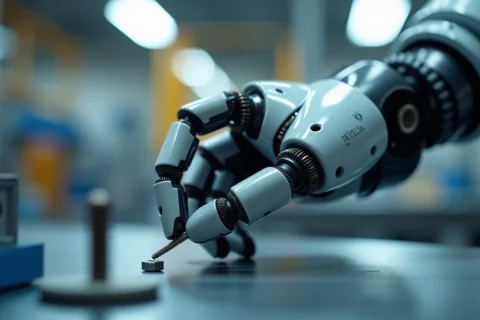
Linkerbot, a Shenzhen-based robotics integration platform, reports a consistent pattern among its industrial clients. Manufacturers are attaching dexterous end-effectors to existing articulated arms rather than acquiring complete humanoid systems. A multi-fingered gripper from Agile Robots or a JAKA-designed manipulator bolts onto a standard ISO flange and performs precision assembly or irregular object handling without requiring legs, a torso, or the software stack necessary for bipedal balance.
This modular approach strips away every subsystem that does not directly generate value for the specific operation. A welding station in an automotive plant needs repeatability to 0.02 millimetres and enough payload capacity to manage a torch. It does not need to climb staircases or shake hands. The humanoid form, shaped by evolution for generalist survival, becomes an expensive liability in a controlled cell with fixed tooling and predictable part presentation.
The economic logic extends through the full lifecycle. A fixed-mount arm from Efort or Siasun draws power only for its six joints during motion. A humanoid performing the identical weld must simultaneously energise ankle servos, hip actuators, and the inertial measurement units processing balance data at hundreds of hertz. The energy overhead converts directly to larger battery packs, more frequent charging cycles, and reduced productive uptime in facilities designed for twenty-four-hour operation.
Where the Supply Chain Is Actually Getting Paid
China’s robotics component manufacturers are recording their first substantial commercial returns from the subsystems that compose humanoid platforms, not from the platforms themselves. Zhejiang Harmonic Drive produces precision reducers that now supply domestic collaborative robot makers previously dependent on Japanese imports. Estun Automation manufactures servo motors and drives at volumes that undercut European competitors by thirty to forty percent. Hikrobot ships vision-guided mobile bases by the thousand to logistics facilities run by JD.com and Cainiao.
These component specialists benefit from a supply chain architecture optimised for modularity. A dexterous hand requires harmonic drives, force-torque sensors, and tendon-actuated fingers. A mobile base needs lidar units, brushless hub motors, and SLAM navigation processors. When these subsystems are sold separately to integrators assembling task-specific solutions, each supplier captures revenue without waiting for the resolution of unsolved problems in humanoid locomotion or whole-body control.
Government industrial policy reinforces this fragmentation. Regional clusters in Shenzhen, Shanghai, and Chongqing receive subsidies for robotics manufacturing that reward production volume and export revenue. A supplier shipping ten thousand grippers to arm integrators generates measurable economic activity more quickly than a humanoid startup burning through venture capital on prototype iterations. The incentive structure favours parts that ship now over platforms that might function later.
The Industries Buying Piece by Piece
Electronics assembly at Foxconn and Huawei facilities illustrates the practical deployment. Articulated arms perform circuit board soldering, component placement, and optical inspection at stations where the work envelope is a fixed cubic metre. Mobile manipulators, AMRs from Geek+ carrying lightweight arms, transport materials between these stations without requiring any bipedal capability. The combination covers material flow and precision operation at a fraction of the complexity budget of a walking assembler.
Automotive manufacturing shows similar patterns at greater scale. Siasun and Efort welding robots populate the body-in-white lines at domestic EV manufacturers. Paint robots from the same suppliers operate in explosive atmospheres where a humanoid’s unsealed joint architecture would introduce unacceptable ignition risks. Battery module assembly at CATL and BYD plants demands the cleanliness and precision of cartesian or SCARA configurations, forms even less anthropomorphic than six-axis arms but optimised for the specific motion profile of cell stacking.
Logistics presents perhaps the clearest case for partial systems. Cainiao’s fulfilment centres deploy thousands of autonomous mobile robots for shelf transport. Where picking is required, a stationary arm at a consolidation point handles the manipulation, while the mobile unit provides transport. The division of labour between mobility and manipulation, each optimised independently, outperforms any current attempt to merge both into a single humanoid platform.
The Battery That Decides the Argument
Current humanoid prototypes operate for one to four hours on a single charge. A factory automation investment is amortised across years of production, with payback periods calculated against labour cost avoidance. Equipment that requires multiple charging cycles per shift, each removing it from production for thirty to sixty minutes, fails the basic arithmetic of throughput. Robot arms draw power through permanent cabling or operate with battery packs sized only for joint motion, not locomotion and balance combined.
The maintenance equation compounds the disparity. A six-axis industrial arm has six motor-encoder sets, a controller, and a teach pendant. Diagnostic routines are standardised across decades of industrial practice. A humanoid contains dozens of actuators, distributed computing nodes, and sensor fusion systems requiring specialised technical support that scarcely exists in China’s maintenance workforce. Downtime for repair converts directly to lost production, and the mean time to repair for novel humanoid architectures remains unproven at scale.
What the Humanoid Hype Obscures
The research investment flowing into full humanoid platforms, from Tesla’s Optimus to domestic efforts by UBTech and Fourier Intelligence, generates legitimate advances in control theory and component miniaturisation. These advances diffuse into the modular ecosystem. A more compact torque sensor developed for a humanoid knee joint becomes available for collaborative arm design. A neural network trained for whole-body balance finds application in mobile base navigation on uneven warehouse floors.
The technology transfer is real. The commercial sequence, however, runs in the opposite direction from the publicity. Subsystems prove themselves in industrial deployment, earn revenue, and only then inform the platforms that might eventually combine them. China’s robotics supply chain is building the profitable middle layer of automation while the humanoid summit remains a research objective. The factories paying for equipment today are not waiting for the walking machine. They are bolting better hands to arms that already work and moving on to the next station.