
Webvan spent a billion dollars proving that automated grocery delivery could not work in 2001. The company built twenty-six robotic warehouses, commissioned a fleet of custom vans, and expanded across multiple US cities before a single market had shown it could turn a profit. When the dot-com bubble burst, the infrastructure-first strategy collapsed. The intellectual property eventually sold to Amazon, which folded it into the slower, more cautious development of Amazon Fresh.
Webvan’s core insight, that consumers would pay for rapid delivery of daily necessities from centralized automated hubs, was sound. The timing was not. The technology could not yet eliminate human labor from picking and packing. Route optimization relied on human dispatchers rather than machine learning. Most critically, the company assumed that building supply chains would create demand, rather than letting dense demand dictate where supply chains should go.
Chinese tech giants have inverted every element of that sequence. Meituan, Alibaba, and JD.com now operate more than ten thousand autonomous delivery vehicles at Level 4 autonomy across Beijing, Shenzhen, and Shanghai. These low-speed bots and flatbed trucks move through public roadways, residential compounds, and university campuses, handing off to smart lockers or doorsteps. The deployment is the visible terminal of a fulfillment system that has already been rebuilt from the ground up to function without human intervention.
The Lights-Out Warehouse
The facilities driving this network are called lightning warehouses, or dark stores, and they bear little resemblance to conventional fulfillment centers. Western distribution hubs are designed around human dimensions: aisle widths for walking workers, lighting and climate control for shift-long occupancy, shelving heights within arm’s reach. Chinese automated facilities discard all of these constraints.
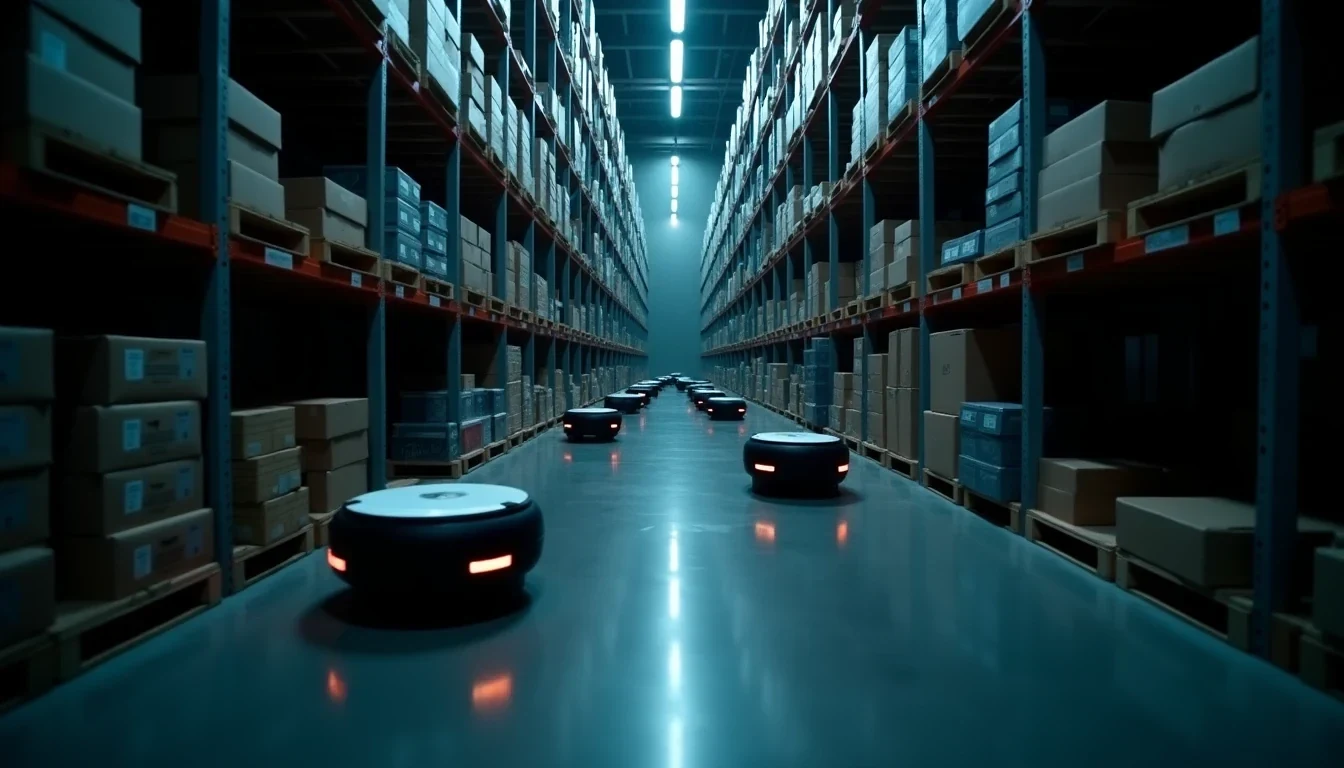
Hundreds of self-charging autonomous mobile robots operate in near-total darkness. Machine vision systems read QR codes on packaging. LiDAR sensors map the environment in real time, allowing robots to thread narrow corridors and vertical storage arrays that no human warehouse worker could efficiently traverse. Robotic arms pick individual items and transfer them to automated conveyor networks. The absence of human comfort requirements, lighting, heating, or ventilation for workers collapses operating costs and compresses the physical footprint into expensive urban cores where land is scarce.
Throughput figures illustrate the density this enables. A single facility can sort up to two hundred thousand packages daily. Order pulling and packing completes in two to three minutes. The constraint is no longer how quickly a human can locate and handle an item. It is how fast the robotic network can coordinate its own movements without collision or idle time.
Predictive Inventory and Hyper-Local Demand
The automation inside the warehouse is matched by intelligence upstream. AI systems analyze purchasing patterns from surrounding housing complexes, identifying neighborhood-specific preferences and demand rhythms that shift by hour, by weather, by local event. Algorithms adjust inventory positioning overnight, ensuring that fast-moving SKUs sit closest to packing stations and that slow movers do not consume premium retrieval time.
This precision allows the lightning warehouse to operate with a smaller physical footprint than a traditional facility serving equivalent volume. In Chinese cities where commercial real estate commands premium prices, the efficiency gain is the difference between a viable node in an instant commerce network and an economically impossible one. The system also minimizes waste. Stock levels align closely to predicted demand because the prediction operates at the scale of individual residential blocks rather than metropolitan statistical areas.
The Economics of Infrastructure-Led Profitability
The shift to heavy automation responds to specific pressures in the Chinese market. Parcel volumes across the country’s e-commerce sector now run to billions annually. Labor costs in first-tier cities have risen steadily, eroding the thin margins that subsidized early instant commerce growth. Consumer expectations have simultaneously hardened. Thirty to sixty minutes is no longer a premium service tier. It is the baseline against which platforms compete.
Chinese tech companies have responded by moving away from the subsidy model that characterized early market share battles. User acquisition through discounted delivery fees has given way to infrastructure-driven profitability. The automated dark store, the autonomous bot fleet, and the AI routing layer represent capital expenditure directed at unit economics rather than customer acquisition. Each order fulfilled through this system costs less than the previous technology generation could achieve, and the gap widens as scale increases.
The Autonomous Hand-Off
The final critical link is the transfer from warehouse to last-mile vehicle. Once robotic arms complete packing, automated conveyors move the order directly to an outbound loading zone. Autonomous flatbed trucks or delivery bots position themselves to receive cargo without human loading. AI systems sequence dispatch to optimize departure timing against delivery promises and real-time traffic conditions.
This continuity matters because every human touchpoint in a fulfillment chain introduces delay and cost. The thirty-minute delivery window does not permit a worker to walk an order to a loading bay, scan it, and wait for a driver to become available. The bot that receives the package from the conveyor may be the same vehicle that arrives at the customer’s smart locker. Level 4 autonomy, with its capacity for unsupervised operation in defined operational design domains, makes this legally and practically achievable in ways that were unavailable to Webvan’s human-driven van fleet.
What Webvan Got Right
Webvan’s collapse was overdetermined: premature national expansion, unproven demand, capital markets that turned hostile, and a technology stack that could not deliver on the operational promises made to investors. Yet the structural vision, centralized automated fulfillment feeding rapid last-mile delivery for daily necessities, has proven durable. It simply required the sensor technology, machine learning, and robotics maturity that arrived two decades later.
Chinese companies have also avoided Webvan’s sequencing error. They built automation in response to demonstrated demand density rather than hoping that infrastructure would summon customers. The lightning warehouse exists where order volume already justifies it. The autonomous bot rolls on routes that human couriers have already proven viable. The system scales by replicating proven nodes, not by betting on national expansion ahead of local validation.
A billion-dollar bankruptcy from the first internet era now reads as a premature execution of an idea that contemporary engineering has finally made economical. The warehouses are darker, the vehicles are driverless, and the inventory moves before the customer has finished placing the order.